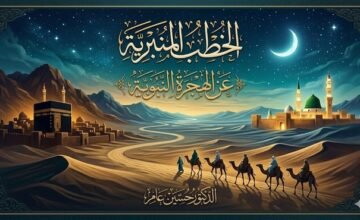
(3) Lessons from the Emigration of the Prophet Mohammad (PBUH)
There are four points to discuss in this regard.
A- Pure Intentions.
B- Good Planning.
C- Making Precious sacrifices.
D- The help and Support of Allah.
Introduction:
Why do we need to talk about the emigration of Prophet Mohammad (PBUH) at this time in particular?.
This is because these days commemorate the beginning of the Hijri year, which make is important to remember the Hijra of the Prophet (PBUH), in order for us to learn new lessons.
These lessons are very important, and are a benefit to the Muslims in the present and the future. Another good reason for us to remember the Hijra is because it is the greatest event in the history of Islam and Muslims at the very early stages. The Hijra marked the change of the state of muslims from weakness to power and from being oppressed to being safe and secure.
More importantly, the Hijra marked the establishment of the Islamic society in Madina. At that point Islam became victorious and prominent and Dawa extended outwards to include people outside of Mecca and those of other religions. The factors which lead to the success of hijra are the following:
A- The pure intention:
Every deed is preceded by an intention, whether good or bad, and that is what determines if the deed is accepted or rejected by Allah. Therefore, the good intention is very important even before the actual deed takes place.
In one hadith the Prophet (PBUH) said: “The deeds are considered by the intentions, and a person will get the reward according to his intentions.
So whoever emigrated for Allah and his Messenger, then his emigration will be for Allah and his Messenger; and whoever emigrated for worldly benefits or for a woman to marry, his emigration would be for what he emigrated for.” (Al-Bukhari, 1).
B- The good planning:
Here are a few things which the prophet (PBUH) did, which demonstrate his good planning.
First, the prophet (PBUH) designated two camels which he and Abu Bakr were going to ride to Madina six months prior to the Hijra, and Abu Bakr prepared them by feeding them well and taking good care of them.
Second, the prophet (PBUH) designated Abu Bakr to be his companion for the journey.
Third, the prophet (PBUH) designated Abdullah Ibn Oraiqit to be their guide for the journey, even though he was not a Muslim. This was because Abdullah was the most familiar person with roads leading to Madina.
Fourth, the prophet (PBUH) designated Abdullah ibn Abu Bakr who was an intelligent and clever young man, to gather news which was vital to the success of the Hijra and the safety of Prophet Mohammad (PBUH) and his companion Abu Bakr. Abdullah Ibn Abu Bakr used to spend the night in Mecca so that he could bring the news to the prophet (PBUH) the next morning.
Fifth, the prophet (PBUH) designated Asma bint Abu Bakr to supply him and her father with food and water. Asma endured many hardships in the carrying out of the duty that she was entrusted with.
Sixth, the prophet (PBUH) designated Amir Ibn Fua’ira, the servant of Abu Bakr, to cover up the trail that was left behind by the Prophet (PBUH) and Abu Bakr. He used to herd his sheep near the cave of Thawr in order to do this more effectively.
Seventh, the Prophet (PBUH) traveled on side roads to make it more difficult for the pagans to get to him.
Eighth, the Prophet (PBUH) stayed in the cave for three days, long enough for the people of Quraish to give up their search for him and Abu Bakr.
In light of these steps taken by the Prophet (PBUH) we can see that the Muslims today are in desperate need for good planning, which is essential to the well being and success of the Muslim society.
C- Making sacrifices with that which is precious:
Every successful deed requires great sacrifices and great effort. The greatest thing that the Prophet (PBUH) did was establishing the muslim nation, and the delivering of the message. For the sake of Allah and supporting the cause of Islam, the companions offered great sacrifices, this includes the following:
Scarifying one’s home. Everybody who made Hijra with the prophet (PBUH) had to leave Mecca which was the place where most of the companions were born and raised. The Prophet (PBUH) said as he was leaving Mecca: “By Allah you (Mecca) are the most beloved place to Allah and the most beloved place to me. If the people of Quraish did not force me out, I would never leave you.” (Al-Daraqutni, 104).
Some companions sacrificed their wives and children for the sake of Allah. A good example of this is the story of Abu Salamah and his wife.
Some companions sacrificed all of their wealth and everything they owned, like the example of Suhaib Ibn Sinan.
There are some companions who made unique sacrifices, like the ones made by Ali Ibn Abi Talib. Ali agreed to sleep in the Prophet’s bed the night he was going to be killed by the people of Quraish. This is considered to be the highest level of sacrifice, when one is ready to loose his life so that the Prophet (PBUH) does not get harmed.
The most important lesson that we can learn from these unique moments from our history is that the success of Dawa requires precious and valuable sacrifices.
Allah (SWT) says: “Say if your fathers, you sons, your brothers, your wives, your kindred, the wealth that you have gained, the commerce in which you fear a decline, and the dwellings in which you delight…are dearer to you than Allah and His Messenger (PBUH), and striving hard and fighting in His Cause, then wait until Allah brings about His Decision (torment). And Allah guides not the people who are Al-Fasiqun (the rebellious, disobedient ones).” (At-Tawba, 24).
D- The Help and support of Allah for Muslims:
- a) When all means have been exhausted, and Muslims don’t achieve their goals, that’s when Allah (SWT) provides additional help and support so that Muslims are always victorious.
The clearest example of this is, when the Prophet (PBUH) and Abu Bakr were in the cave of Thawr, and the pagans were looking for them in the same area. At that point Abu Bakr got very worried and said “O messenger of Allah, if one of them looks under his feet he will be able to see us.”
The Prophet (PBUH) said: “O Abu Bakr, what do you think about two persons with whom Allah is third? Don’t be sad, Allah (SWT) is with us.” (Al-Bukhari, 4663).
- b) And in the story of Suraqah the pagan who came very close to capturing the prophet (PBUH). Allah made his horse sink in quick sand.
This proves that the Prophet (PBUH) who is a carrier of the message of Allah and receives revelation from him is being watched over and protected by Allah at all times.
One poet said: “If the support of Allah and his protection is upon you, then you can sleep soundly and safely.”
We ask Allah (SWT) to make us among the people whom he protects and supports.
May Allah accept from me and you and all of us.
Written by: Dr. Ahmed A. S. Hammouda
Professor in Al-Azhar University
And Islamic American University
Translated by: Abdullah Zettili